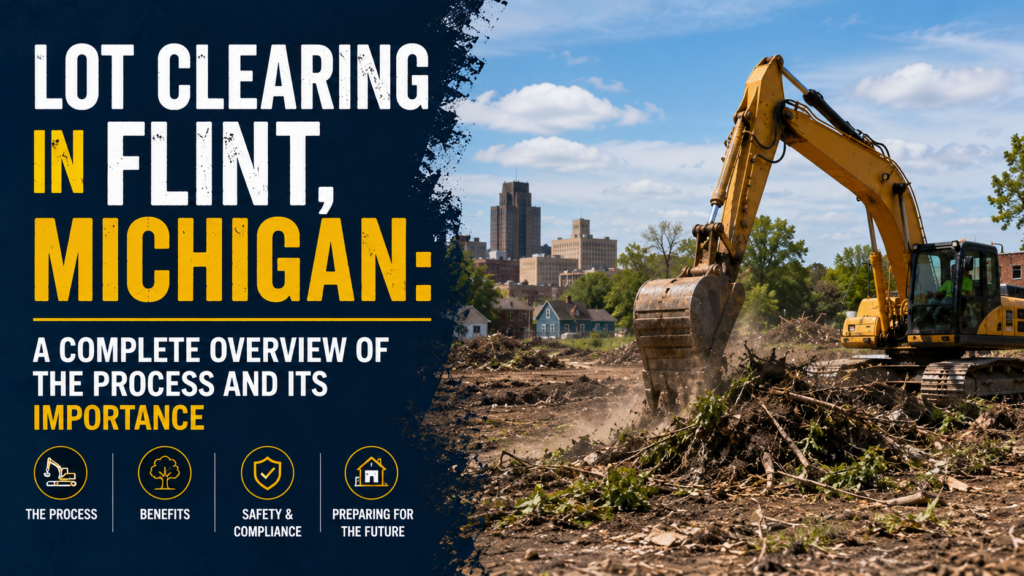
Lot clearing is one of the most foundational services in the construction and land development industry. Before a single foundation can be poured, a driveway installed, or a garden planted, the land must first be prepared cleared of trees, brush, debris, and other obstacles that would interfere with safe and efficient development. In Flint, Michigan, Lot Clearing Flint carries added significance given the city’s ongoing revitalization efforts and the growing need to reclaim and repurpose vacant or overgrown parcels of land.
This article explains what lot clearing involves, the methods commonly used, the types of properties that benefit from it, the regulatory considerations that apply in Michigan, and why professional services are critical for achieving the best outcomes.
What Is Lot Clearing?
At its most basic level, lot clearing is the process of removing all unwanted vegetation, trees, stumps, brush, rocks, and debris from a piece of land to prepare it for a new use. Whether that use is a new home, a commercial building, an agricultural field, a recreational area, or simply a clean and safe lawn, the goal of lot clearing is the same: to create a level, unobstructed canvas on which future work can take place.
The scope of a lot clearing project can vary enormously depending on the condition and history of the land. A recently vacant residential lot in an urban setting may require little more than the removal of overgrown brush and a few small trees. A rural parcel that has been left untended for decades, on the other hand, may involve dense woodland, invasive species, decades of accumulated debris, and terrain that presents significant challenges for equipment operators.
Methods Used in Lot Clearing
Professional lot clearing contractors employ a variety of methods depending on the type and volume of vegetation present, the condition of the soil, the intended use of the land, and environmental considerations.
Manual clearing involves the use of hand tools and smaller power equipment chainsaws, brush cutters, and similar implements to remove vegetation with precision. This method is well-suited for properties where selective clearing is needed, such as when certain trees or plants are to be preserved while others are removed.
Mechanical clearing uses excavators, bulldozers, skid steers, and similar heavy equipment to clear larger volumes of vegetation quickly. This approach is more efficient for densely vegetated lots but requires skilled operators who understand how to work in close proximity to structures, utility lines, and sensitive areas.
Forestry mulching is an increasingly popular technique that uses a specialized machine to cut down trees and vegetation and grind them into fine mulch in a single pass. The mulch is spread directly on the ground, improving soil health, minimizing erosion, and eliminating the need for separate hauling and disposal. This approach causes less soil disturbance than traditional clearing methods and is widely used in Michigan for both residential and commercial lot clearing projects.
The Lot Clearing Process: Step by Step
Every successful lot clearing project begins with a thorough site assessment. An experienced contractor walks the property with the owner to understand the project goals, identify any features to be preserved, locate underground utilities, and determine the most effective clearing strategy. This walk-through is essential for ensuring that the final result matches what the property owner actually wants.
Following the assessment, the contractor develops a detailed plan and schedules the appropriate equipment and crew. Before machinery arrives on site, any necessary permits are obtained. In Michigan, permit requirements for lot clearing vary by location and depend on factors such as the risk of soil erosion, the number of trees being removed, proximity to wetlands, and whether the property is subject to local zoning ordinances or environmental review.
The physical clearing phase typically begins with the removal of smaller brush and vegetation, followed by the felling and removal of larger trees. Stump grinding or removal follows, since stumps left in the ground can complicate grading, interfere with future construction, and become tripping hazards. Final grading ensures the surface is level, properly sloped for drainage, and ready for whatever comes next.
Why Lot Clearing Matters in Flint
Flint has faced significant challenges related to vacant and blighted properties over recent decades, stemming from population decline, economic hardship, and the legacy of industrial contraction. Thousands of lots across the city have sat vacant and overgrown for years, creating safety hazards, attracting illegal dumping, and diminishing the quality of life in surrounding neighborhoods.
Lot clearing is a critical tool in reversing this trend. When overgrown parcels are properly cleared, they become productive again whether as sites for new construction, community gardens, pocket parks, expanded driveways, or simply maintained green spaces that neighbors can enjoy. Clearing also eliminates fire hazards created by accumulated dry brush and reduces the habitat available to pests that thrive in overgrown environments.
For property owners in Flint who are preparing to build, landscape, or sell their land, professional lot clearing represents an investment that directly increases the usability and value of the property. A cleared lot is also far easier to sell or finance than one buried in vegetation, since lenders and buyers can readily assess what they are acquiring.
Types of Properties That Benefit from Lot Clearing
Lot clearing is not limited to large rural tracts. In an urban context like Flint, the service is regularly used for residential lots of varying sizes, commercial parcels being prepared for new development, lots acquired through tax foreclosure that have been sitting vacant for extended periods, and side lots adjacent to existing homes where owners wish to expand usable outdoor space.
Homeowners who have purchased a new lot for custom construction use lot clearing to prepare the site before excavation and foundation work begins. Farmers or rural landowners use it to reclaim fields that have been overtaken by invasive vegetation. Property managers use it to bring unmaintained commercial land back to a presentable standard. In all cases, the underlying goal is the same: to transform land from an unusable or hazardous state into one that can be put to productive use.
Environmental and Regulatory Considerations in Michigan
Michigan has a robust set of environmental protections that can affect lot clearing projects, particularly those involving properties near water bodies, wetlands, or areas designated as environmentally sensitive. The Michigan Department of Environment, Great Lakes, and Energy (EGLE) oversees regulations governing soil erosion, sedimentation, and activities in or near wetland areas.
Property owners should be aware that removing trees or disturbing soil on a parcel may trigger requirements for erosion controls such as silt fencing, sediment basins, or erosion blankets, particularly on sloped properties or those adjacent to drainage features. In many cases, a professional lot clearing company will handle the permit process on behalf of the property owner, using their knowledge of local requirements to ensure full compliance.
Why Professional Lot Clearing Is the Right Choice
While it may be tempting to attempt lot clearing independently, the reality is that professional services offer substantial advantages in efficiency, safety, and outcome quality. Heavy equipment operation requires specialized training and experience; errors can result in damage to underground utilities, nearby structures, or the property itself. Professionals also have established relationships with disposal facilities for timber, brush, and construction debris, ensuring that removed material is handled in compliance with local regulations.
Additionally, an experienced lot clearing company in the Flint area will understand the specific conditions of Genesee County the soil types, typical vegetation species, seasonal considerations, and local permitting requirements that affect how a project should be approached. That local knowledge is difficult to replicate without years of hands-on experience in the region.
Conclusion
Lot clearing is a foundational step in virtually any land development or improvement project. In Flint, where the revitalization of vacant and underused properties is an ongoing community priority, professional lot clearing services play a vital role in transforming neglected land into spaces that can support new homes, businesses, and community uses. Understanding the process, the methods available, and the regulatory framework that governs the work helps property owners make informed decisions and work effectively with the contractors who can bring their vision to life.